
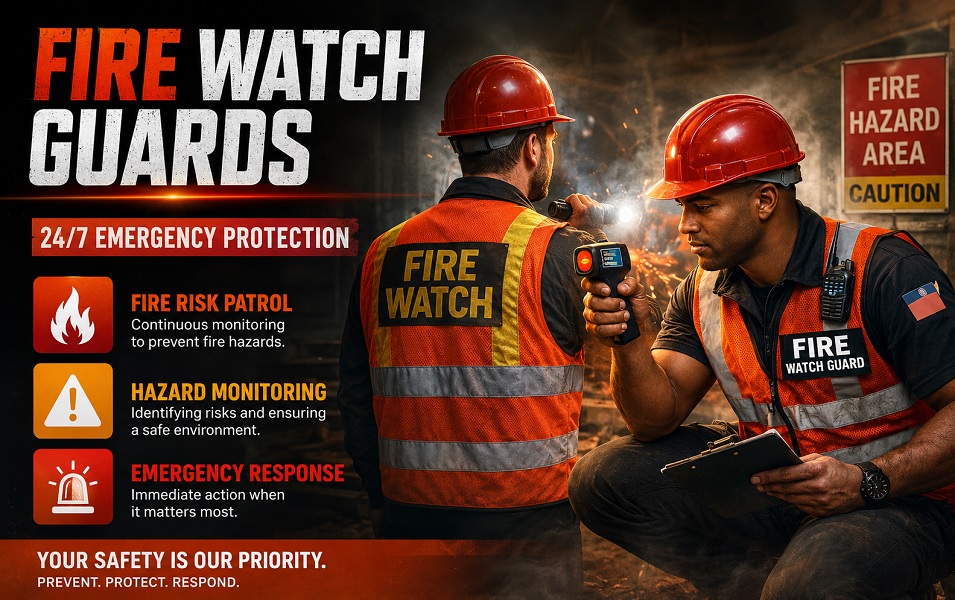
A single spark. That’s all it takes. One overlooked ember in a stairwell, one faulty sprinkler system left unmonitored during maintenance, one night shift where nobody was watching — and a building that took years to build disappears in hours. The threat of fire is always present, but what most property owners and site managers fail to reckon with is the invisible web of risks that accumulate silently, long before any flame appears. Fire Watch Guards exist precisely to intercept those risks before they become tragedies.
This isn’t just a safety topic. It’s a business survival conversation.
When Your Fire Suppression System Goes Offline, Your Vulnerability Skyrockets
Modern buildings are engineered with layers of fire protection — sprinkler systems, alarm networks, smoke detectors, suppression systems. These tools work quietly in the background, and most facility managers trust them completely. That trust becomes dangerous the moment one of those systems goes down for maintenance, repair, or an unexpected malfunction.
During those gaps — sometimes hours, sometimes days — a building is operating without its primary line of defense. Contractors keep working. Employees keep showing up. Operations don’t pause. But the safety infrastructure that everyone relies on is no longer functioning.
This is precisely where professional fire watch services step in. Trained guards patrol the property continuously, identify ignition sources, monitor high-risk areas, and maintain real-time logs that document every observation. They are the human failsafe when technology fails.
The insurance and liability implications alone make this non-negotiable. Most commercial insurance policies require active fire watch coverage when suppression systems are offline. Skipping it doesn’t just risk lives — it risks coverage, legal standing, and the business itself.
The Construction Site Problem Nobody Talks About Loudly Enough
Walk through any active construction site and you’ll encounter a cocktail of fire hazards that would alarm any fire marshal: open-flame welding, cutting operations, stored flammables, unfinished electrical systems, and temporary structures with zero fire resistance. Construction sites are, statistically, among the most fire-prone environments in the country.
Yet many site managers treat fire safety as a compliance checkbox rather than an operational priority.
Hot work — welding, grinding, torch cutting — generates sparks and heat that can smolder inside walls, insulation, and debris for hours before igniting. By the time a fire becomes visible, it’s often already inside the structure. This phenomenon, known as delayed ignition, is one of the most underappreciated dangers in construction.
Experienced fire watch personnel are trained specifically for this. After hot work concludes, they maintain post-work watch periods — typically 30 to 60 minutes, though longer in high-risk scenarios — scanning for hidden heat sources, smoldering materials, and early smoke indicators. Without this watch, a crew could pack up and leave, confident everything is fine, while a slow burn quietly escalates inside the walls.
The National Fire Protection Association has documented countless incidents where fires broke out hours after hot work ended. Many were entirely preventable with proper post-work monitoring. The guards don’t just watch for fire — they watch for the conditions that make fire inevitable.
Chemical Storage, Industrial Facilities, and the Compounding Risk Factor
Industrial environments carry a fire risk profile that is fundamentally different from commercial office buildings. Chemical storage areas, manufacturing floors, warehouses with high-rack flammable inventory, oil refineries, and power generation facilities all operate under elevated baseline hazard conditions. In these environments, the margin for error isn’t just smaller — it’s nearly nonexistent.
A single ignition event in a chemical storage facility can trigger cascading reactions. Accelerants spread fire faster than suppression systems can respond. Certain materials burn at temperatures that defeat standard sprinkler coverage. The complexity of these risks demands a human presence that understands fire behavior, not just a passive alarm system waiting to be triggered.
Fire Watch Guards stationed in these environments do far more than observe. They conduct regular patrols with structured checklists, identify improperly stored materials, flag equipment running hot, document anomalies, and coordinate with emergency services when escalation is necessary. Their presence also enforces behavioral compliance — workers are far less likely to take shortcuts around flammable materials when trained safety personnel are actively present.
There’s a psychological dimension here that data rarely captures. Accountability changes behavior. When people know someone qualified is watching, they become more careful. That cultural shift alone reduces incident probability in measurable ways.
The Regulatory Pressure Is Real — and It’s Growing
Fire codes across the United States are not static. Local fire marshals, the International Fire Code, OSHA regulations, and NFPA standards are constantly evolving in response to incident data and structural changes in how buildings are used. For property managers, developers, and facility operators, staying ahead of these requirements isn’t optional — it’s a legal and financial imperative.
Municipalities in states like California, New York, Texas, and Florida have increasingly mandated fire watch coverage in scenarios that go well beyond impaired suppression systems. Events exceeding certain occupancy thresholds, buildings undergoing major renovation, facilities with documented code violations — all of these can trigger mandatory fire watch requirements that carry significant fines for non-compliance.
The paper trail matters here too. Professional fire watch services maintain detailed logs that serve as documented evidence of compliance. In the event of an incident investigation or insurance claim, those records become critical. The difference between a covered claim and a denied one can come down to whether someone was actively monitoring the premises and documenting what they observed.
Cutting corners on fire watch coverage to save money is one of those decisions that looks reasonable until the moment it doesn’t. And by that point, the cost is rarely just financial.
What Separates Professional Fire Watch from Simply “Having Someone Around”
Not everyone with a radio and a safety vest qualifies as a legitimate fire watch guard. This distinction matters more than most people realize when they’re evaluating vendors or deciding how to implement a fire watch program.
Trained fire watch personnel understand fire behavior, extinguisher operation, evacuation protocols, hot work hazard recognition, and the specific requirements of NFPA 101 and local fire codes. They know how to read a building — where heat collects, where ventilation creates risk, where materials interact dangerously. They communicate with site supervisors and document every patrol with the kind of precision that holds up in a regulatory audit.
An untrained security guard asked to “keep an eye out for fire” is not a fire watch program. It’s a liability dressed up as a solution.
This is why working with established, specialized fire watch providers makes a meaningful operational difference. Companies like Just Fire Watch bring dedicated expertise to this narrow but critical discipline. The institutional knowledge embedded in a professional fire watch team — the training protocols, the documentation systems, the understanding of jurisdiction-specific requirements — is genuinely difficult to replicate with general-purpose staffing.
The Real Cost of Underestimating Fire Risk
There’s a bias that runs through most organizations when it comes to fire risk: because a major fire hasn’t happened here before, the probability feels abstract. This is survivorship thinking, and it’s a dangerous way to manage risk.
The U.S. fire loss statistics tell a different story. Structural fires cause billions of dollars in property damage annually. Commercial and industrial fires displace workers, destroy inventory, terminate leases, and in the worst cases, end businesses entirely. The recovery timeline for a serious fire can stretch beyond what most companies can sustain — even with insurance.
Beyond the physical damage, there are the human costs. Employees injured or displaced, contractors held liable, communities affected. Fire isn’t just a property problem. It’s a people problem.
The organizations that take fire watch seriously aren’t doing so out of excessive caution. They’re doing it because they’ve done the math. The cost of professional fire watch coverage, measured against the potential losses from a single preventable fire, isn’t even close. It’s one of the clearest return-on-investment calculations in risk management.
Vigilance Is Not Passive — It’s a Strategy
The built environment is full of silent variables — aging wiring behind finished walls, chemicals slowly degrading in storage, hot work residue hidden in structural cavities. Fire doesn’t announce itself until it’s too late to prevent it. What changes the outcome is whether a trained, attentive human being was present in the right place at the right moment.
That is what fire watch guards represent at their best: a proactive layer of human intelligence deployed against risks that technology alone cannot fully address. The fire that never starts doesn’t show up in incident reports. It doesn’t make headlines. But it represents something enormously valuable — a business that stayed open, a building that survived, a crew that went home safely.
The smartest operators in real estate, construction, manufacturing, and events don’t wait for a close call to take fire watch seriously. They build it into the plan from the beginning, treat it as a strategic investment rather than a regulatory burden, and choose providers who understand that every patrol matters.
Because somewhere in the building, at this very moment, there’s a risk nobody else is watching for.